

Why buy in Mexico
Mexico offers a clear legal route to owning a home, with professional due diligence and a public notary overseeing closing.
- A clear legal path for foreigners. Mexican law lets foreigners own residential property, including on the coast, through a bank trust (see section 04).
- Experienced professionals. Bilingual real estate attorneys and public notaries handle due diligence and closing.
- A growing, dynamic market with plenty of homes and land at competitive prices.
- Advantages for foreigners, including tax benefits and permanent residency programs.

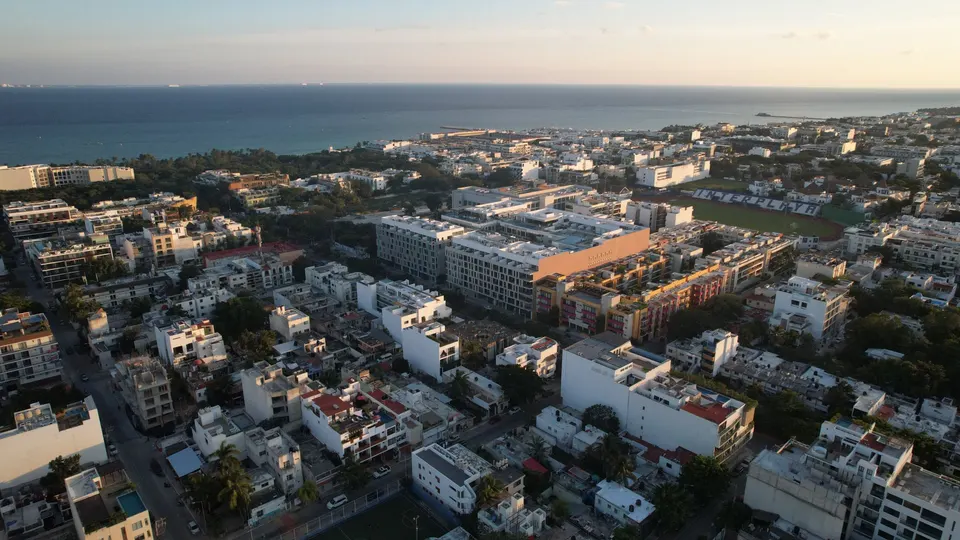
The Riviera Maya (Playa del Carmen, Tulum, Cancún, Cozumel, Bacalar, Puerto Aventuras, Isla Mujeres) is served by three international airports: Cancún, Tulum and Cozumel.
How a purchase works, step by step
Choose a property, make a written offer, sign a purchase agreement, complete due diligence, and close before a public notary.
Buying in Mexico is simple and similar to buying at home. The paperwork is what matters, so every step is supervised by an attorney and closed before a public notary.
- Choose the property. Shortlist on video calls or in person; we send floor plans, prices and real unit videos.
- Written offer. You submit a written offer for the property.
- Purchase agreement. If the seller accepts, a purchase agreement is signed. It is the legal basis of the whole transaction (section 03).
- Due diligence. Your attorney confirms the property is free and clear, without debts, and that the seller is the rightful owner.
- Payments. Deposits and payments follow the schedule in the agreement, and can be protected in escrow (section 07).
- Physical inspection. Before closing, the property is inspected to confirm it has no visible defects and includes the furniture, fixtures and improvements agreed in the contract.
- Legal closing (public deed). The agreement is formalised in a public deed (the title) before a public notary, who in Mexico is both an attorney and a government official.
- Registration. The notary pays the taxes on behalf of buyer and seller, assembles all documents and records the deed in the Public Registry.
The purchase agreement and your attorney
The purchase agreement sets the terms of the transaction; have an independent attorney review it before you sign.
The most important document
The purchase agreement is the legal basis of the transaction. It sets out the buyer, the seller, the property, the price, the payment schedule and the delivery dates, among other essentials.
It must be unequivocally clear and not open to interpretation, with the obligations of buyer and seller well defined.
What your real estate attorney does
- Title research. Confirms the property is free and clear, without debts, and that the seller is the rightful owner.
- Drafts the purchase agreement through which both parties take on their obligations.
- Formalises the agreement through a public deed (the title), the official legal document later recorded in the Public Registry.
Our approach
We work with independent bilingual real estate attorneys on every transaction, so you always know what you are signing. Ask us for an introduction before you sign anything.
Owning as a foreigner: the bank trust
A fideicomiso gives foreign buyers rights to use, sell and pass on coastal residential property through a renewable 50-year bank trust.
Within 50 km of the coastline or 100 km of a border (the "restricted zone", which includes the whole Riviera Maya), foreigners hold residential property through a bank trust called a fideicomiso.
How it works
- A Mexican bank acts as trustee and holds legal title. You are the beneficiary with full ownership rights: to use, enjoy, lease, build, sell, transfer or mortgage the property.
- The trust carries no legal disadvantage or risk; the bank cannot use or sell the property.
- The buyer can be an individual or a legal entity, Mexican or foreign.
- You can name substitute beneficiaries in case of death, which avoids costly and complicated probate.
- The legal basis is Article 27 of the Mexican Constitution and the Foreign Investment Law.
- The trustee bank charges an annual fee. Keep the receipts; you will need them when you sell.
Other trusts you may hear about
- Guarantee trust: assets are held by a neutral fiduciary as security until an obligation is fulfilled, then released.
- Administration trust: a professional third party manages funds or assets under clear, neutral rules.
- Real estate development trust: how developers organise the legal and financial structure of a project.

Buying through a company or an IRA
A company or a qualifying self-directed IRA may be an option, subject to independent legal and tax advice about the proposed structure.
You can buy as an individual, through a Mexican or foreign legal entity, and it is even possible to use an IRA account to purchase property in Mexico.
Using an IRA
Depending on the circumstances, you may be asked to form a legal entity that receives the funds to acquire the property.
Foreign companies
A foreign legal entity that does business in Mexico must formalise its incorporation documents:
- Notarised.
- Apostilled with the Secretary of State's office.
- Translated into Spanish by an officially approved translator.
Closing costs, taxes and owning costs
The source guide illustrates closing costs of about 4–9%; obtain a current written quote for your specific purchase.
At closing
- The public notary collects the closing costs, including government fees and taxes. On average they are 4% to 9% of the purchase price, depending on the location and the recorded purchase price.
- Acquisition tax (ISABI): a municipal tax paid when you acquire property, about 3% in Cancún. It is calculated on the highest of the purchase price, the appraisal value and the cadastral value, and must be paid within 15 days.
- Tourism promotion tax (Quintana Roo): 10% of the ISABI amount.
- The notary pays the taxes on behalf of buyer and seller and records the deed in the Public Registry.
Once you own
- You pay the utilities and running costs: water, electricity, gas, property tax, homeowners' association (HOA) fees and, with a trust, the annual trustee bank fee.
- Property tax is very low, because it is based on the assessed value, not the market value. A home worth about USD 280,000 pays around USD 350 a year.
- Pay early, pay less: paying the next year's property tax in advance in December often earns a 20–25% discount.
Figures are typical ranges at the time of writing; your notary confirms the exact amounts for your property.
Paying safely: financing and escrow
Your payment can be held safely in escrow, set up by an independent lawyer.
Two questions every buyer from abroad asks: can I finance it, and is my money safe?
Developer financing
- Selected developers finance directly over 3, 5 or 7 years at about 9–10%.
- No credit check for foreign buyers.
- You can live in the home, or rent it, while you are paying.
- Prepayments go straight to the principal.
- The down payment is typically 50% (from 20% on some projects) and is negotiable.
- The deed is issued in your name once the home is fully paid.
Subject to developer approval and the terms for the selected unit.
Escrow: your payment protected
Paying from Canada or the US
- Payments are made by international bank transfer, to the account named in the purchase agreement or the escrow instructions.
- Always confirm bank details by phone or video with your advisor before you send money.
Residency in Mexico
No. You do not need Mexican residency to own property; immigration status and ownership are separate matters.
Mexican law allows foreigners to live, work and immigrate. You do not need residency to own property, and many owners who spend long periods here never become residents, but permanent residency brings benefits, including tax deductions when you sell (section 09).
How to apply
- Applications for temporary or permanent residency are reviewed by the Mexican Consulate in your state, or the one nearest to you. Book an appointment through the consulate's website (consulmex.sre.gob.mx).
- Bring your passport and a copy, and proof of address and a copy. The consulate may ask for more documents case by case.
- When the consulate finishes, you receive documents to take to the immigration office in the Mexican city where you will live.
- There they are exchanged for the residency card you applied for. This step takes less than 2 months.
Selling a property
An attorney and public notary coordinate the legal transfer and applicable taxes; confirm your personal position with independent advisors.
Statistically, owners sell within 6 to 7 years, so plan ahead from the day you buy to avoid high closing costs, including capital gains tax.
The process
- An interested buyer submits an offer.
- If you accept, a purchase agreement is drawn up, clear and not open to interpretation.
- The agreement is formalised through a public deed (the legal closing), recorded in the Public Registry.
Documents to have ready
- Property title, recorded in the Public Registry.
- Property tax payment receipt.
- Letter of no debt for HOA fees (if the property is in a condominium).
- Federal Maritime Zone tax receipt (if the property is next to the federal zone).
- Utility receipts: water, phone, electricity, gas, among others.
- Trustee bank fee receipts (if the property is held in a trust).
Seller's closing costs
- Certificates of no debt, issued by the government, showing no debt for property tax, water and sewage, among others.
- Attorney fees, so you fully understand the obligations you take on.
- Realtor fees, usually 5% to 7% of the sale price. Always get an invoice: it is deductible against capital gains tax.
- Capital gains tax, up to 35% of the profit, which can be reduced (next page).
- State cedular tax on the seller's net gain, 2% to 5%.
Capital gains tax, and how to reduce it
As in other countries, you pay capital gains tax (ISR) if you make a profit on a sale. The notary calculates and withholds it at closing. The old rules that fully exempted any profit have changed, but deductions can lower the tax, sometimes to zero.
The primary-residence exemption
The tax authority (SAT) allows a large exemption from the profit when the home is your residence. The guide this section is based on put it at around MXN 4,000,000; the law sets it at up to 700,000 UDIs (an inflation-indexed unit, so the peso amount rises over time). It can be used once every 3 years if you own several properties in Mexico, and you need:
- Permanent resident card (for a foreign seller).
- Proof of address in the seller's name at the property sold: electricity, water or phone, with an invoice.
- Mexican tax ID (RFC) from the SAT.
Other deductions
- Invoiced broker or agent fees.
- Invoiced improvements to the property, such as construction (furniture and equipment do not count).
Plan before you list
A tax review before you put the property on the market lets your attorney audit your documents and plan the sale legally and financially. Keep every invoice from the day you buy.
Tax rules change; confirm current amounts with your notary or attorney before you sell.
See it first: the Chill Out Weekend
The Chill Out Weekend is a four-day, three-night IPANA viewing trip at USD 399, credited back if you buy, subject to current confirmation.
Stay in the building before you decide.
- Airport transfers: Cancún – Playa del Carmen – Cancún
- 3 nights in a professionally managed condo at IPANA
- Lunch in downtown Playa del Carmen
- Property and area tour, plus a private session with a property advisor
- No high-pressure sales pitch. Thursday to Sunday works best; dates are flexible and subject to availability.
Jakob Kravik
Licensed real estate advisor · Riviera Maya & all Mexico
WhatsApp +52 984 137 55 45
jakob@unlimited-possibilities.com
unlimited-possibilities.com